CRYPTO AFTER THE HYPE
Where Digital Assets Are Actually Being Used
Beyond Bitcoin prices and speculative trading, a quieter transformation is taking place. Stablecoins, tokenized assets and blockchain infrastructure are beginning to find practical roles in payments, international business and the traditional financial system.
For years, cryptocurrency was dominated by one question:
How high—or how low—will the price go?
Bitcoin rallies generated headlines. New tokens appeared almost overnight. Fortunes were created and lost, while celebrities, entrepreneurs and investors rushed into a market that sometimes seemed driven as much by excitement as technology.
But beneath the speculation, something more important has been developing.
In 2026, the digital-asset conversation is increasingly moving toward utility.
Can blockchain make an international payment faster?
Can dollars move globally outside traditional banking hours?
Can ownership of financial assets be represented digitally?
Can securities settle more efficiently?
Can companies automate portions of financial transactions?
And can these innovations operate within a regulated financial system people can trust?
Those questions are creating the next chapter of digital finance.
1. STABLECOINS: THE PRACTICAL SIDE OF CRYPTO
One of the biggest developments isn’t a cryptocurrency designed to dramatically increase in price.
It is a digital asset designed not to.
Stablecoins are digital tokens generally designed to maintain a stable value relative to another asset—most commonly the U.S. dollar.
Instead of asking whether a token will double in value, the objective is usually much simpler:
One digital dollar should remain approximately one dollar.
That makes stablecoins potentially useful for payments and settlement.
By 2026, their role had become significant enough that payment companies, financial institutions and governments were examining them as part of the future financial infrastructure.
Visa reported in 2026 that local-currency stablecoin transfer volume had increased dramatically since 2023, with usage expanding beyond simply holding the assets into payments, settlement and treasury management.
The attraction is easy to understand.
Money can potentially move across blockchain networks continuously—without waiting for traditional banking hours.
2. INTERNATIONAL PAYMENTS
Moving Money Across Borders
Sending money within one country can feel almost instantaneous.
Sending it internationally can be very different.
Cross-border payments may involve multiple financial institutions, currencies, fees and settlement systems.
Stablecoins offer another possible route.
A business could potentially convert traditional currency into a regulated dollar-backed stablecoin, transfer it digitally and allow the recipient to convert it into local currency.
The IMF has acknowledged that stablecoins have the potential to make certain cross-border payments and remittances faster and less expensive.
This could be especially important for:
International businesses.
Freelancers working across borders.
Families sending remittances.
Importers and exporters.
Companies managing international suppliers.
But faster technology doesn’t eliminate regulatory responsibilities.
Anti-money-laundering rules, sanctions compliance, consumer protection and identity verification remain essential.
The future of global payments will require both speed and trust.
3. STABLECOIN CARDS
Digital Money Meets Everyday Shopping
One of the most interesting developments is connecting stablecoins with something consumers already understand:
Payment cards.
A person may hold stablecoins in a digital wallet while using a linked card to purchase ordinary products and services.
Behind the scenes, technology handles the conversion and payment process.
In July 2026, stablecoin-linked card spending exceeded $1 billion globally for the month, according to payment-industry data cited by Reuters.
That is still tiny compared with the overall global card market, but it demonstrates an important transition.
Digital assets don’t necessarily need every merchant to understand blockchain.
The consumer may use new financial infrastructure while the merchant receives familiar currency through an existing payment network.
That is often how technology becomes mainstream:
The complexity disappears from the user experience.
4. TOKENIZATION
Putting Traditional Assets on Digital Rails
Stablecoins may be the most visible practical use of blockchain, but tokenization could ultimately have an even larger impact.
Tokenization means representing an asset or financial claim digitally on a programmable ledger.
Imagine shares of an investment fund, bonds or other financial assets existing in tokenized form.
The underlying economic asset isn’t necessarily new.
The infrastructure is.
The IMF has described tokenization as potentially changing the architecture of finance because transactions that currently require separate stages—such as execution, clearing and settlement—could increasingly occur through shared digital infrastructure.
This could potentially make financial markets more efficient.
It could also create new risks.
When the infrastructure changes, regulators must understand where responsibility, liquidity and operational risk move with it.
5. TOKENIZED TREASURIES & FUNDS
Traditional Finance Comes Onchain
One of the clearest signs that digital assets are moving beyond their speculative origins is the growing interest in tokenizing familiar financial products.
Rather than inventing a completely new cryptocurrency, financial companies can represent traditional instruments on blockchain infrastructure.
Government securities and money-market products are particularly interesting because they connect one of the world’s oldest financial markets with one of its newest technologies.
The appeal can include:
Faster settlement.
Greater automation.
Potential 24-hour accessibility.
Programmable transactions.
More efficient collateral movement.
The important point is that blockchain doesn’t necessarily have to replace traditional finance.
It may increasingly become part of the technology underneath traditional finance.
6. BANKS ARE ENTERING THE CONVERSATION
For years, crypto and banking were often portrayed as opposing worlds.
That distinction is becoming less clear.
Financial institutions are experimenting with tokenized deposits, blockchain settlement and digital assets.
Banks have an important advantage: customers already trust them to hold money, provide credit and operate within established regulatory frameworks.
Crypto infrastructure has another advantage: it can allow assets to move on programmable digital networks.
Combining those strengths could create a new generation of financial products.
The future may therefore not be:
Crypto replaces banks.
It could be:
Banks become more blockchain-enabled.
7. PAYMENT NETWORKS ARE BUILDING THE BRIDGE
Traditional payment companies aren’t simply watching this development.
They are experimenting with it.
Visa, for example, has been expanding stablecoin settlement capabilities and reported in April 2026 that its stablecoin settlement pilot had reached a $7 billion annualized run rate.
The company subsequently introduced additional infrastructure intended to help financial institutions and payment providers access stablecoin capabilities.
This is significant because mainstream adoption may depend less on convincing billions of consumers to understand blockchain terminology and more on integrating new technology into financial services they already use.
Consumers don’t need to understand exactly how an international payment is routed today.
They simply expect it to work.
Digital assets may eventually succeed in the same way.
8. GOVERNMENTS ARE MOVING FROM “WHAT IS CRYPTO?” TO “HOW DO WE REGULATE IT?”
Perhaps the clearest indication that digital assets are maturing is government involvement.
In the United States, the GENIUS Act established a federal framework for payment stablecoins. In August 2026, the U.S. Treasury began seeking public comment as it developed rules implementing parts of that framework.
The expected effective date for major issuer requirements is January 2027.
Other governments are developing their own approaches.
The United Kingdom is examining how its financial system can support innovation involving stablecoins and tokenized finance while maintaining financial stability.
Europe has developed a broad regulatory framework for crypto-assets.
Financial centers across Asia and the Middle East are also developing rules and experimenting with digital finance.
The debate is no longer simply about whether crypto should exist.
It is increasingly about how it should fit into the financial system.
9. BLOCKCHAIN MAY BECOME INVISIBLE
The internet became revolutionary when people stopped thinking constantly about the internet itself.
When someone watches a movie online, they don’t usually think about the networking protocols delivering it.
They simply watch.
Blockchain could eventually follow the same path.
Consumers may not care whether the infrastructure underneath a payment uses blockchain.
Businesses may care primarily that settlement becomes faster or cheaper.
Investors may care that assets become easier to transfer or manage.
Banks may care about efficiency and compliance.
If blockchain becomes successful infrastructure, the word itself may become less important.
The technology could disappear into the background.
10. AI + DIGITAL MONEY
When Machines Can Make Payments
An entirely new question is emerging:
What happens when artificial intelligence can control a budget and make authorized payments?
AI agents are beginning to perform increasingly sophisticated tasks—searching for services, booking travel, purchasing computing resources and managing business processes.
Digital money and programmable payment infrastructure could eventually allow software to complete financial transactions automatically within predefined limits.
Imagine a business AI system authorized to:
Reorder inventory when stock runs low.
Pay a supplier after delivery is verified.
Purchase cloud computing when additional capacity is required.
Book approved business travel.
Automatically move excess cash according to company rules.
This remains an emerging area, but it demonstrates why programmable money could become important far beyond cryptocurrency trading.
THE RISKS HAVE NOT DISAPPEARED
Practical use doesn’t mean digital assets are risk-free.
Stablecoins can lose their intended peg.
Digital wallets can be compromised.
Smart contracts can contain vulnerabilities.
Fraud remains a major problem.
Crypto markets can be extremely volatile.
Regulatory requirements differ between countries.
And consumers may mistakenly assume every digital asset has government protection similar to a traditional bank account.
The Bank for International Settlements has warned that stablecoins still present important challenges involving financial stability, monetary sovereignty and the fundamental characteristics expected of money.
The IMF has similarly warned that widespread foreign-currency stablecoin use could create problems for some emerging economies, including currency substitution and more volatile capital flows.
Innovation therefore needs guardrails.
CRYPTO IS GROWING UP
The first era of crypto was about proving that digital assets could exist.
The second era was dominated by speculation.
The next era may be about something much less glamorous—but potentially far more important:
Infrastructure.
Moving money.
Settling transactions.
Representing assets.
Managing collateral.
Automating financial processes.
Connecting international businesses.
Providing new payment options.
The biggest winners may not necessarily be the cryptocurrencies generating the loudest headlines.
They could be the technologies consumers barely notice.
FROM SPECULATION TO UTILITY
Crypto’s future won’t be determined simply by the price of Bitcoin.
The larger question is whether blockchain-based financial infrastructure can solve real problems better than existing alternatives.
Can it make international payments faster?
Can tokenization make markets more efficient?
Can regulated stablecoins provide useful digital payment infrastructure?
Can financial institutions use programmable networks without sacrificing security, compliance and trust?
Those questions are finally beginning to receive as much attention as token prices.
And that may be a sign of progress.
The future of digital assets may not be about replacing money.
It may be about changing how money and assets move.
WHERE DIGITAL ASSETS ARE ACTUALLY BEING USED
01 — STABLECOINS
Digital dollars and other currency-linked tokens.
02 — CROSS-BORDER PAYMENTS
Moving value internationally with potentially fewer intermediaries.
03 — PAYMENT CARDS
Connecting stablecoin balances with traditional merchant networks.
04 — TOKENIZED ASSETS
Representing traditional financial assets on digital ledgers.
05 — TOKENIZED TREASURIES & FUNDS
Bringing established investments onto programmable infrastructure.
06 — BANK SETTLEMENT
Banks exploring tokenized deposits and blockchain-based financial infrastructure.
07 — INSTITUTIONAL PAYMENTS
Payment networks experimenting with blockchain settlement.
08 — INTERNATIONAL FINANCE
Businesses using digital assets for treasury and global money movement.
09 — PROGRAMMABLE MONEY
Transactions capable of following predefined digital rules.
10 — AI COMMERCE
The emerging possibility of authorized AI agents making payments automatically.
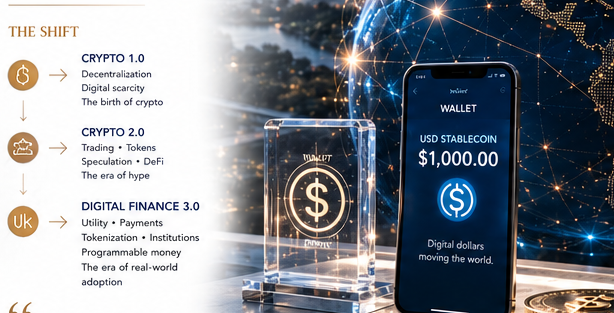
THE DIGITAL FINANCE SHIFT
CRYPTO 1.0
Bitcoin • Decentralization • Digital scarcity
CRYPTO 2.0
Trading • Tokens • Speculation • DeFi
DIGITAL FINANCE 3.0
Stablecoins • Tokenization • Payments • Institutions • Programmable money
THE BIG IDEA
The most important development in crypto may be that it is becoming less about crypto itself. Blockchain is increasingly being tested as financial infrastructure—and the ultimate sign of success may come when ordinary people use it without even knowing it is there.