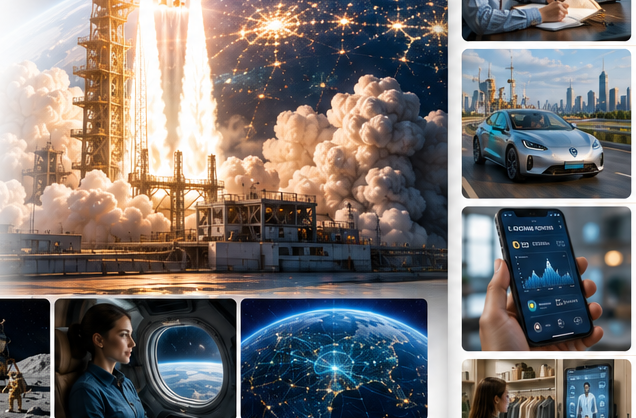
THE NEW SPACE ECONOMY
From NASA to Private Enterprise
Rockets may capture the world’s attention, but the real space revolution is much bigger. Satellites, communications, lunar missions, private companies, tourism and an expanding network of businesses are turning space into one of the world’s most fascinating new economic frontiers.
For most of modern history, going to space was something only governments could do.
The United States and Soviet Union competed to reach orbit and the Moon. NASA became a symbol of American scientific achievement. Astronauts became international heroes, while the enormous cost and complexity of spaceflight kept most private companies—and virtually every private citizen—firmly on Earth.
That world is changing.
Governments remain essential, but they are increasingly sharing the space economy with commercial launch providers, satellite operators, communications companies, manufacturers, technology startups and private investors.
The result is a new kind of space race.
This time, the prize isn’t simply planting a flag.
It is building an economy.
FROM GOVERNMENT PROGRAM TO COMMERCIAL MARKETPLACE
NASA isn’t disappearing from America’s space future.
Its role is evolving.
Rather than having government design and operate every component itself, NASA increasingly works with private companies for services ranging from transportation to the International Space Station to lunar technologies and scientific missions.
This model can allow government agencies to focus resources on ambitious exploration and research while commercial companies develop technologies and services that may eventually serve multiple customers.
The relationship between government and industry is therefore becoming less about NASA versus private enterprise and more about NASA helping create an environment in which a larger commercial ecosystem can develop.
And that ecosystem reaches far beyond rockets.
1. SATELLITES: THE BUSINESS ALREADY ABOVE US
The largest part of the space economy isn’t necessarily the part that produces spectacular launch videos.
It is satellites.
Satellites quietly support enormous parts of modern civilization.
They help provide:
Communications
GPS and navigation
Weather forecasting
Television broadcasting
Internet connectivity
Agricultural monitoring
Mapping
Disaster response
Scientific research
National security
A farmer examining satellite imagery, a ship navigating an ocean, a driver following GPS directions and an emergency team tracking a hurricane may all be using space-based infrastructure.
This is why the space economy shouldn’t be viewed as something happening far away.
Much of its value is created here on Earth.
2. PRIVATE ROCKETS CHANGE THE EQUATION
Launching anything into space has traditionally been extraordinarily expensive.
Commercial launch companies have been working to change that equation through new manufacturing approaches, greater launch frequency and, most visibly, reusable rocket technology.
Reusability matters because historically much of a launch vehicle was used once.
Imagine if an airline discarded its airplane after every flight.
The economics would be terrible.
Reusable rockets don’t make spaceflight inexpensive or simple, but recovering and reusing major components can change the economics of launch.
Companies such as SpaceX, Blue Origin and Rocket Lab illustrate different parts of an increasingly diverse commercial launch and space-services market.
Competition could ultimately provide customers with more options for reaching orbit.
And every reduction in the cost and difficulty of access creates possibilities for businesses that couldn’t previously afford to participate.
3. THE MOON BECOMES A BUSINESS DESTINATION
More than half a century after the Apollo era, the Moon is again becoming a major destination.
NASA’s Artemis program is intended to establish a new era of lunar exploration while developing capabilities that could eventually support missions farther into the solar system.
But today’s lunar ambitions include a much larger commercial component.
Private companies are developing lunar landers, communications technologies, scientific instruments and other services.
That creates an intriguing possibility.
Instead of every organization building its own spacecraft to reach the Moon, companies may eventually be able to purchase transportation or services from specialized providers.
It is similar to what happened with aviation.
Most businesses don’t build their own airplanes.
They buy transportation.
The same principle could eventually reshape access to space.
4. SPACE TOURISM: FROM ASTRONAUTS TO PRIVATE PASSENGERS
For decades, the idea of ordinary people traveling to space belonged to science fiction.
It no longer does.
Private individuals have already flown on commercial space missions, while companies are developing different approaches to human spaceflight.
Virgin Galactic has pursued suborbital tourism, while Blue Origin has flown private passengers aboard New Shepard. Commercial orbital missions have demonstrated another model for private human spaceflight.
For now, space tourism remains extraordinarily expensive and available to very few people.
But many luxury industries began as experiences accessible only to the wealthiest customers.
Commercial aviation itself was once a novelty.
Whether space tourism eventually becomes broadly accessible remains uncertain, but its existence creates an entirely new category of luxury experience.
Imagine the future businesses surrounding it:
Specialized training.
Luxury hospitality.
Medical screening.
Insurance.
Travel planning.
Photography and media.
Private astronaut experiences.
Eventually, perhaps even orbital hotels.
The space traveler could become a completely new type of luxury consumer.
5. THE DATA ECONOMY FROM ORBIT
Some of the most valuable things coming from space aren’t physical objects.
They are data.
Earth-observation satellites can collect information about agriculture, weather, infrastructure, forests, oceans, cities and environmental changes.
Businesses can transform that information into useful services.
An agricultural company might analyze crop conditions.
An insurance company could assess damage after a natural disaster.
Energy companies could monitor infrastructure.
Governments could analyze environmental changes.
Mapping companies could update geographic information.
This creates an important business model:
Collect information in space. Create value on Earth.
Artificial intelligence makes this even more powerful.
Satellites can generate enormous amounts of imagery and data. AI can help identify patterns within it.
The combination of AI + satellites could become one of the most commercially important intersections in the new space economy.
6. INTERNET FROM SPACE
Billions of people still lack reliable high-speed internet access.
Satellite networks are becoming part of the effort to change that.
Large constellations of satellites in low Earth orbit can provide internet connectivity across areas where traditional infrastructure may be difficult or expensive to build.
Starlink has made satellite broadband one of the most visible consumer applications of today’s commercial space industry.
Other companies and governments are developing competing systems.
The implications go beyond streaming movies in remote areas.
Connectivity can affect education, healthcare, business, emergency response and economic development.
In this sense, satellites are becoming another layer of global communications infrastructure.
7. MANUFACTURING FOR SPACE
Every rocket, satellite, spacecraft and lunar lander contains thousands of components.
Someone has to manufacture them.
That creates opportunities for companies producing:
Advanced materials.
Semiconductors.
Sensors.
Cameras.
Solar panels.
Batteries.
Communications equipment.
Navigation systems.
Robotics.
Precision components.
Software.
Thermal-management systems.
Space therefore creates opportunities for companies that may never launch a rocket themselves.
This is similar to the automobile industry.
The world’s largest automakers are surrounded by enormous networks of suppliers.
As the space industry grows, its supplier ecosystem may become increasingly important.
8. BUILDING IN SPACE
One of the more futuristic possibilities is manufacturing products in space itself.
Microgravity creates conditions different from those on Earth, potentially allowing researchers to experiment with materials, pharmaceuticals, crystals and other products in unusual ways.
The International Space Station has served as an important research platform.
Future commercial stations could potentially expand these possibilities.
The question isn’t whether every product should be manufactured in orbit.
It is whether certain high-value products can be made better—or studied more effectively—under conditions that don’t exist on Earth.
If the answer becomes yes for even a few important categories, an entirely new manufacturing sector could emerge.
9. THE COMMERCIAL SPACE STATION
The International Space Station has been one of history’s greatest examples of international scientific cooperation.
But the next generation of orbital stations may include commercial facilities.
Companies are developing concepts for privately operated stations that could support research, manufacturing, government missions, private astronauts and potentially tourism.
Think of them less like traditional government laboratories and more like business parks in orbit.
Different customers could purchase access for different reasons.
A pharmaceutical company might conduct research.
A government might train astronauts.
A media company could film content.
A wealthy traveler might visit.
A manufacturer could test production in microgravity.
If commercial stations succeed, low Earth orbit could begin developing something resembling a genuine marketplace.
10. THE BUSINESSES THAT DON’T EXIST YET
The most exciting opportunities may be the ones we haven’t named.
The early internet produced businesses that would have sounded strange beforehand.
Search engines.
Social networks.
Streaming platforms.
App stores.
Influencers.
Cloud computing.
Entire industries emerged only after the underlying infrastructure existed.
Space may follow the same pattern.
Once transportation, communications and orbital infrastructure become more available, entrepreneurs may discover uses nobody originally anticipated.
Tomorrow’s space companies could specialize in:
Orbital servicing.
Space debris removal.
Satellite repair.
Lunar communications.
Space-based energy.
In-orbit construction.
Resource exploration.
Private research.
Entertainment.
Specialized insurance.
Space cybersecurity.
And businesses we haven’t imagined yet.
SPACE NEEDS CYBERSECURITY TOO
As satellites and space infrastructure become increasingly important to everyday life, protecting them becomes critical.
A satellite is not simply a machine floating above Earth.
It can be part of a communications or navigation network with enormous economic importance.
That makes space cybersecurity an emerging field.
The new space economy will need engineers and astronauts—but also programmers, lawyers, financial experts, cybersecurity professionals, insurance specialists, designers and entrepreneurs.
Space is becoming multidisciplinary.
A GLOBAL SPACE RACE
America isn’t alone.
China has built a major national space program and its own space station.
India has demonstrated growing capabilities, including successful lunar exploration.
Europe, Japan, the United Arab Emirates and other nations continue investing in space science and technology.
This creates both competition and opportunities for international cooperation.
The new space economy will be global.
The countries that develop strong launch capabilities, satellite industries, engineering talent and supportive commercial ecosystems could capture significant portions of this emerging marketplace.
SPACE COMES BACK TO EARTH
It is easy to think about space as somewhere far away.
But the most important question for business is often much closer:
What problem on Earth can space technology solve?
Better communications?
More accurate weather forecasting?
Improved agriculture?
Faster disaster response?
Global internet access?
More precise navigation?
New scientific discoveries?
When space technology solves real problems, it stops being simply exploration.
It becomes infrastructure.
THE NEXT GREAT ECONOMIC FRONTIER
The first space race asked:
Who can reach space first?
The new space economy asks something very different:
What can we build once we’re there?
Governments will remain essential.
NASA will continue pushing scientific exploration.
But alongside government missions, an increasingly diverse commercial economy is developing—launch providers, satellite companies, data businesses, manufacturers, communications networks, tourism ventures and entrepreneurs.
The rocket is only the beginning.
What matters is everything that can be built around it.
The next chapter of the space age may not be written only by astronauts and scientists.
It may also be written by entrepreneurs.
THE SPACE ECONOMY: 10 OPPORTUNITIES TO WATCH
01 — COMMERCIAL LAUNCH
Reusable rockets • Smaller launch vehicles • Mission services
02 — SATELLITES
Communications • Navigation • Weather • Earth observation
03 — LUNAR ECONOMY
Landers • Science • Communications • Transportation
04 — SPACE TOURISM
Private astronauts • Luxury experiences • Future orbital hospitality
05 — EARTH DATA
Agriculture • Climate • Insurance • Mapping • Infrastructure
06 — SATELLITE INTERNET
Global connectivity • Remote communities • Emergency communications
07 — SPACE MANUFACTURING
Components • Materials • Electronics • Specialized suppliers
08 — IN-ORBIT PRODUCTION
Research • Pharmaceuticals • Materials • Microgravity manufacturing
09 — COMMERCIAL SPACE STATIONS
Research • Government missions • Tourism • Business
10 — NEW SPACE SERVICES
Cybersecurity • Satellite repair • Debris removal • Insurance • Robotics
FROM EARTH TO ORBIT TO THE MOON
TODAY:
Satellites + Launch + Communications
NEXT:
Commercial stations + Lunar services + Space manufacturing
THE FUTURE:
A permanent economy operating beyond Earth
THE BIG IDEA
Space is evolving from a destination explored primarily by governments into infrastructure used by businesses. The companies that define the next era may not simply be those that reach space—but those that discover how to create value once they get there.