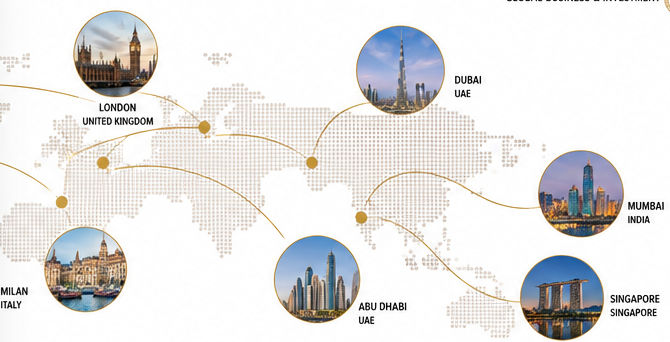
THE NEW GLOBAL WEALTH MAP
Where Money Is Moving in 2026
From the United States and the UAE to Singapore, Europe and rapidly emerging economies, a new generation of entrepreneurs and investors is changing the geography of global wealth.
The world’s wealth map is being redrawn.
For generations, cities such as New York, London, Paris, Los Angeles and Hong Kong dominated conversations about wealth, investment and international business. They remain enormously important, but in 2026 they are sharing the stage with a growing collection of financial, technology and lifestyle destinations attracting entrepreneurs, investors, family offices and international companies.
Money today is more mobile. So are the people who control it.
Entrepreneurs can build businesses across several countries, investors can manage international portfolios from a smartphone, and wealthy families are increasingly establishing multiple bases around the world to gain access to business opportunities, talent and desirable lifestyles.
The numbers demonstrate just how significant global wealth has become. Knight Frank estimates that the worldwide population of ultra-high-net-worth individuals—people with net worth above $30 million—grew from approximately 551,000 in 2021 to more than 713,000 in 2026. North America accounts for about 37% of this population, followed by Asia-Pacific at nearly 31% and Europe at just over 25%.
But where is all this money going?
AMERICA REMAINS A WEALTH POWERHOUSE
Despite increasing international competition, the United States remains at the center of global wealth creation and investment.
In 2025, the United States was both the world’s largest recipient and largest source of foreign direct investment, according to UN Trade and Development.
New York continues to command international attention as a financial and business capital. Los Angeles combines entertainment, technology, luxury real estate and international commerce. Miami has developed an increasingly prominent identity connecting North America, Latin America and international wealth, while technology and entrepreneurial centers across California, Texas and other states continue attracting investment.
America’s greatest advantage may be the extraordinary diversity of its economic ecosystem. Technology, artificial intelligence, entertainment, finance, healthcare, biotechnology, aerospace, energy, real estate and consumer brands can all create significant investment opportunities within the same economy.
And while capital is becoming more global, the United States continues to produce wealth at remarkable scale. Knight Frank expects America to add more ultra-high-net-worth individuals during the next five years than the entire existing ultra-wealthy populations of some world regions.
DUBAI AND THE UAE: A NEW CROSSROADS OF GLOBAL WEALTH
Few places illustrate the changing wealth map better than the United Arab Emirates.
Dubai has transformed itself into an international center for luxury real estate, tourism, aviation, hospitality, finance and entrepreneurship, positioned geographically between Europe, Asia and Africa.
Its luxury property market provides a particularly dramatic example. Dubai recorded 500 residential transactions above $10 million in 2025, while the UAE remained a global leader in the super-prime residential market. Abu Dhabi is also gaining attention among ultra-wealthy individuals looking for an alternative within the Emirates.
The significance of the UAE goes beyond spectacular buildings and luxury lifestyles. Its appeal increasingly comes from connectivity—the ability to bring international investors, businesses, professionals and capital together in one location.
SINGAPORE: SMALL COUNTRY, GLOBAL INFLUENCE
In Asia, Singapore continues to demonstrate that economic influence isn’t determined by geographic size.
The city-state combines financial services, international commerce, technology, wealth management and connectivity to the wider Asian economy.
Singapore remained among the world’s five largest recipients of foreign direct investment in 2025.
It has also become an increasingly important location for wealthy families and international investors. Knight Frank’s 2026 research notes that while London and New York remain major centers, Dubai, Hong Kong and Singapore are gaining momentum as wealthy families establish multiple bases around the world.
For entrepreneurs looking toward Asia, Singapore offers something especially valuable: access. From one highly developed business center, companies can connect with some of the world’s fastest-growing markets.
INDIA’S WEALTH STORY IS ACCELERATING
One of the most important countries to watch may be India.
India’s population of individuals worth more than $30 million increased by approximately 63% between 2021 and 2026, reaching nearly 20,000, according to Knight Frank’s 2026 wealth analysis.
Foreign investment is moving as well. India’s FDI inflows increased 44% to approximately $39 billion in 2025, according to UNCTAD.
Mumbai’s luxury market reflects part of this wealth creation, but India’s larger story involves technology, manufacturing, financial services, infrastructure, consumer markets and entrepreneurship.
With a vast population and expanding business ecosystem, India represents both a source of new wealth and a destination for international capital.
EUROPE IS CHANGING—NOT DISAPPEARING
Europe’s established wealth capitals remain important, but money is becoming more selective about where it lands.
London continues to be one of the world’s great financial centers, yet changes in taxation and the increasingly mobile lifestyles of wealthy individuals are creating opportunities for other European destinations.
Cities such as Milan and Madrid are capturing some internationally mobile capital, while luxury and lifestyle destinations including Marbella continue attracting affluent buyers.
This doesn’t necessarily mean investors are abandoning traditional capitals. Instead, many wealthy individuals are spreading their lives and assets among several cities.
The billionaire of the future may not simply have one primary residence and one headquarters. A family could have business interests in America, investments in Europe, a residence in Dubai and financial relationships in Singapore.
That is one of the defining characteristics of the new wealth map: wealth increasingly operates without a single home address.
THE EMERGING MARKETS TO WATCH
Perhaps the most interesting changes are happening outside the traditional centers of wealth.
Knight Frank identifies Indonesia, Saudi Arabia, Poland and Vietnam among the maturing economies expected to experience notable growth in their ultra-high-net-worth populations over the next five years. Australia is another standout, with its ultra-high-net-worth population forecast to increase by almost 60%.
Southeast Asia is attracting additional international investment. In 2025, foreign direct investment increased by 51% in Malaysia and 30% in Thailand. In Latin America, Brazil remained the region’s largest FDI recipient, with inflows rising 23% to approximately $77 billion.
These numbers are important because tomorrow’s luxury consumers, investors and multinational businesses will not necessarily emerge from yesterday’s wealth centers.
AI IS ALSO REDIRECTING CAPITAL
The new global wealth map isn’t only about geography. It is also about what investors are funding.
Global foreign direct investment increased 6% to approximately $1.6 trillion in 2025, ending two consecutive years of decline. However, the recovery was highly concentrated: the world’s top 20 host economies attracted more than 80% of global FDI.
One of the biggest magnets for investment has been technology.
Major projects involving artificial intelligence and digital infrastructure contributed significantly to the recent increase in global investment.
The implications extend far beyond Silicon Valley. Countries increasingly understand that AI requires enormous supporting infrastructure—data centers, energy, semiconductor capacity, communications networks, specialized talent and investment capital.
The competition to become an AI center is therefore also becoming a competition for global wealth.
LUXURY IS BECOMING AN EXPERIENCE
The definition of wealth itself is changing.
Luxury once emphasized visible possessions: the mansion, automobile, watch, yacht or art collection. Those assets haven’t disappeared, but wealthy consumers are increasingly placing value on experiences, personal development, wellness, mobility and quality of life.
Knight Frank’s 2026 Wealth Report describes an evolution in luxury spending away from purely conspicuous consumption and toward experiences connected with personal growth and transformation.
That shift creates opportunities far beyond traditional luxury goods.
Luxury hospitality, wellness retreats, longevity clinics, private aviation, branded residences, exclusive experiences, education, personalized healthcare and high-end travel can all participate in the new wealth economy.
WHERE WILL MONEY MOVE NEXT?
There may no longer be one answer.
New York and the United States remain powerful. Dubai and Abu Dhabi are rising. Singapore continues to connect global capital with Asia. India is creating wealth rapidly. European cities are competing for increasingly mobile investors, while emerging markets from Southeast Asia to the Middle East and Latin America are demanding greater attention.
The winners of the next decade will likely be places that offer more than favorable investment opportunities.
They will need talent, infrastructure, technology, connectivity, security, lifestyle, education and an environment where entrepreneurs believe they can build something meaningful.
Global wealth is not simply moving from West to East or from one financial capital to another.
It is becoming more mobile, more diversified and more international than ever before.
And as the world’s entrepreneurs and investors decide where to live, build, invest and create, they are simultaneously drawing a completely new global map of opportunity.
THE 2026 GLOBAL WEALTH WATCH
UNITED STATES
Global leader in wealth creation, technology, capital and entrepreneurship.
UAE
Dubai and Abu Dhabi continue gaining prominence in global wealth, luxury property and international business.
SINGAPORE
A strategic financial and business gateway connecting international capital with Asia.
INDIA
Rapid wealth creation, entrepreneurship and expanding international investment.
EUROPE
Traditional centers remain influential while Milan, Madrid and lifestyle markets compete for mobile wealth.
EMERGING MARKETS
Saudi Arabia, Indonesia, Vietnam, Poland, Malaysia, Thailand and other developing centers deserve increasing attention.
THE BIGGEST GLOBAL TREND:
Money isn’t simply moving to one new destination. Wealth itself is becoming global.